

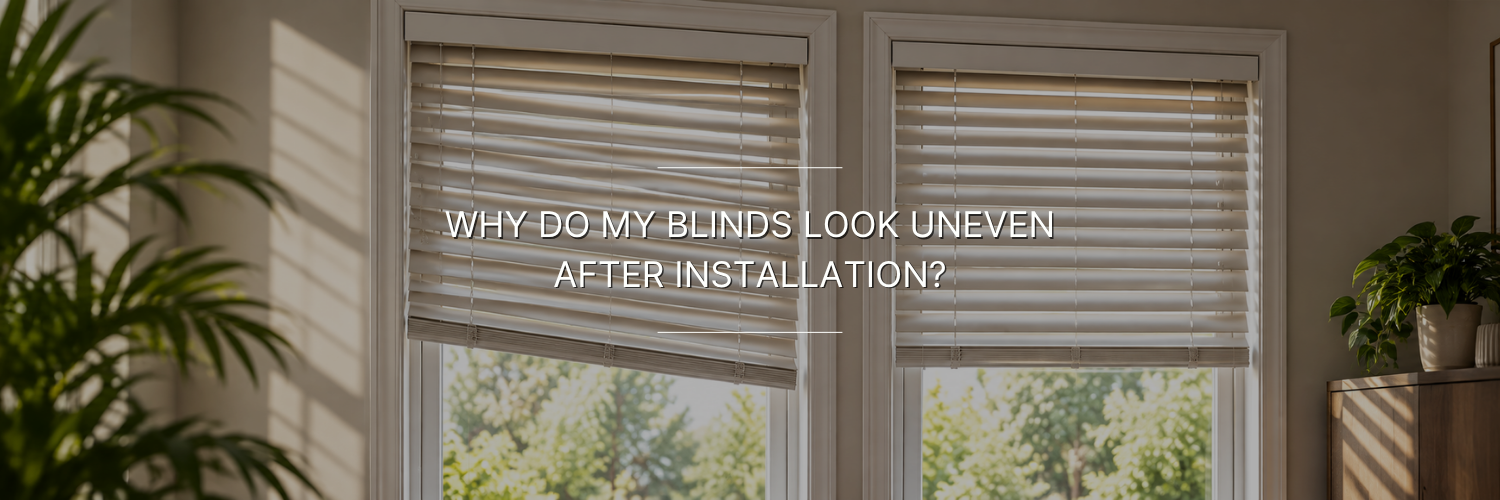
You’ve finally installed your new blinds, but something doesn’t look right. One side seems lower than the other, the slats don’t line up properly, or the blind doesn’t sit straight. If your blinds look uneven after installation, don’t worry. It doesn’t always mean the blinds themselves are faulty. In many cases, the problem comes down to the window, measurements or installation.
Here are some common reasons why it happens.
1. Your Window May Not Be Completely Level
This is something many homeowners don’t realise. Windows can look perfectly straight to the eye but still have small differences in their width, height or level. Even a slight difference can become noticeable once blinds are installed.
This is especially common in older homes where the window frame may have shifted slightly over time.
Before installing blinds, it’s important to check the window frame and measure it at different points rather than assuming all four sides are exactly the same.
2. The Blinds May Not Have Been Measured Correctly
Accurate measurement is one of the most important parts of blind installation. If the width or height has been measured incorrectly, the blind may not sit properly inside or outside the window frame.
For example, if one side has less clearance than the other, the blind can appear crooked even when the installation itself is straight.
This is why custom-made window blinds should be measured carefully before they are ordered.
3. The Brackets May Not Be Aligned
Sometimes the issue is simply with the brackets. If one bracket is installed slightly higher or lower than the other, the blind will naturally hang at an angle.
This can be more noticeable with roller blinds, where the top tube makes the alignment very easy to see. If you notice that the entire blind is tilted, check whether the mounting brackets are sitting at the same height.
4. The Blind May Not Be Sitting Properly in the Brackets
Even when the brackets are installed correctly, the blind itself needs to be positioned properly. If the roller tube or headrail hasn’t been fitted correctly into the brackets, one side may sit differently from the other.
Don’t force it into place. If the blind is newly installed, it’s better to have the installer check the fitting rather than trying to adjust the hardware yourself.
5. The Slats May Look Uneven Even When the Blind Is Straight
This can happen with Venetian blinds. The blind itself may be correctly installed, but the slats can look uneven if they aren’t tilted in the same direction or if the cord mechanism isn’t positioned correctly.
Before assuming there’s an installation problem, fully raise and lower the blind once and adjust the slats evenly. If the problem continues, the mechanism may need to be checked.
6. Your Window Frame May Be Affecting the Final Look
Sometimes the blind is straight, but the surrounding window frame isn’t. This can create the impression that the blind is crooked.
For example, if the top of the window frame slopes slightly, a perfectly level blind may actually look uneven against it.
This is why a professional installer usually checks both the window opening and the surrounding frame before fixing the blind.
How Can You Prevent Uneven Blinds?
A little attention before installation can prevent most of these problems.
- Measure the window at multiple points.
- Check whether the frame is level.
- Use the correct brackets for the blind.
- Make sure both brackets are installed at the same height.
- Don’t rely on visual measurements alone.
- Get professional installation for large or complex windows.
If you’re choosing new blinds, Vista offers roller blinds and other window blind styles that can be customised according to your window requirements.
What If Your Blinds Are Already Uneven?
First, don’t immediately replace them.
Check whether the issue is coming from the brackets, measurements, window frame or blind mechanism. If the blind was professionally installed, contact the installer and ask them to check the alignment.
For simple issues, adjusting the brackets may solve the problem. But if the window itself isn’t level or the blind has been incorrectly measured, it may require a more detailed fix.